Showing posts with label Snapshots / Travel. Show all posts

Saturday, January 20, 2007

Urban Tokyo Series - pt.1: Doujunkai Apaato and your New Hills Lifestyle!

Really Architecture is proud to present a new 8-part series on urban Tokyo. This series of columns will be penned by our guest writer/correspondent - Darryl Wee, urbanite hipster and former guest-Parisian/Bostonian currently teaching English in Tokyo. We hope that this series of entries may inspire our readers to take a fascination with the soul behind our urban environments.

In a city known for feverish new development and a generally shinier patina than most, gracefully decaying buildings are something of a Tokyo marvel. The average lifespan of public housing, shuugou juutaku or danchi projects, is 30 years. Especially during the feverish era of postwar rebuilding, entire tracts of faceless "tofu" apartment complexes materialized overnight; in an effort to rehouse maximum numbers of people at minimal cost, they were often in slapdash materials, marred by haphazard workmanship. Walls and floors were thin, uninsulated, prone to leakages and fractures.

Subsequently, and usually within that narrow 30-year horizon, upwardly mobile residents got fed up of dealing with the repairs, and simply upped and moved elsewhere, or else tore down and rebuilt in something more "modern," like concrete, tile and aluminium. Because they were provisional structures in the first place, preservation and heritage were never on the cards at all. Those housing blocks that were not part of this mass rehousing scheme, built before the war and spared the blitzing of Tokyo, however, were of a much higher quality.

(This was during a time before the rather twee self-branding campaigns began - now danchi are danchi, apartments are (non-public) apartments, "heights" denote a little more luxury, and "mansions" are a guarantee of comprehensive "western" mod cons like dishwashers and *gasp* combination toilet-bathrooms).

In other large metropoles, mid-century architecture, especially of the Corbusian "Unities of Habitation" variety, has become a motherlode of perfumed ruins, prized as "authentic" historical blank canvases for architects and photographers to install their studios in...Tokyo's the same (and very probably more smitten. In any cool cafe worth its half its pretentions, the magazine rack is sure to have the Casa Brutus "BIG 3 extra issue" featuring all the forgotten and obscure works by Corb, Wright and Mies - including an unbelievably curated architour of Chandigarh).

Perhaps this pre-war/post-war rift in quality control has fueled an even greater obsession with the charmingly creaky and paint-peeling walk-up tenements, sometimes with hardly anything else to recommend them except their venerable age. As recently as the Bubble 80s, though, Tokyoites were too busy speculating in French country chateaus and Manhattan penthouses to pay much attention to their own native deadstock of public housing, known collectively as the Doujunkai apartments.


Originally numbering 16 projects in Tokyo and Yokohama built in the late 1920s and early 30s, the sturdy, practical construction in reinforced concrete (fireproof and earthquake-resistant), ample ventilation and natural light made them ideal for dense inner city living. The majority were dismantled in the 80s, and presently only two remain, in the eastern "downtown" (shitamachi) districts of Uenoshita and Minowa.

More recently, there have been some sensitive facade treatments and adaptive reuse, however. Daikanyama, a satellite residential district of Shibuya, is something of an ongoing (half-century, and counting...) study in public housing on a human scale. Maki Fumihiko's Hillside Terrace, a sort of proto-Metabolist housing project, used clever partitioning and layering in an attempt to revive the idea of a "commons" in a public housing project. It has hosted unfinished alterations and progressive annexes since the 60s.

The Daikanyama Doujunkai was "upgraded" in 2000 to become the more condominium-ish Daikanyama Address. All this is somewhat besides the point, if you consider that Daikanyama, together with adjacent Nakameguro and Ebisu, is now part of one of the most gentrified sections of the city, cheek-by-jowl with discreet bars, sidewalk and canal-bank cafes, boutiques and all the rest of it. If the Doujunkai has "survived" in Daikanyama, perhaps it's only as some kind of token communal landmark that can then be safely reworked, helping to bolster land prices and spur on the nostalgia industry...

The other recent metamorphosis is of course Ando's Omotesando Hills, a studiously unconventional shopping mall that recalls the graceful curves of the New York Guggenheim; sure, it's about shopping and rabid consumerism, but at least Ando tries to disguise those ugly motives with his trademark artisanal concrete, sloping walkways and sensitive skylighting. The former Aoyama Doujunkai survives as the "gallery wing" of the complex (home to a number of art galleries) that shows off the open plan stairwells and simple frontal balconies to best effect.


Behind all this apparently sensitive redevelopment, however, is the sinister master vision of one Mori Minoru, who has in the past decade or so syndicated his network of "Hills": a sort of 21st century urban template of Bigness (I wonder what Koolhaas would have to say about this) for a scattershot Tokyo, a city he sees as languishing in the face of competition from Shanghai, Bangkok and Singapore.

His diagnosis isn't incorrect, but the prospect of his network of Hills, each one a vertically-integrated playground of curated leisure for moneyed internationals, strikes me as a Ballardian nightmare of super-rich gated communes. Already he has five major Hills in place; the first, Atago Green Hills, was completed in 2001, and Omotesando Hills opened to sharply-dressed mobs only last year. He stumbled a little over Roppongi Hills, because of the number of people he had to buy out and resettle, but the trend seems unlikely to abate.

Tokyo "Midtown", another live-work-play megaplex, is scheduled to sprout in the same neighborhood in a couple years. Like some kind of global superstructure plastered onto the lowrise Tokyo landscape, Mori's Hills would be appalling even in Singapore or Shanghai, but they are especially depressing in Tokyo, a city I trusted would be mature enough to fend off the grandiose urban ideals of some meddlesome technocrat.

For more of Darryl's writings, click here.


Friday, January 19, 2007

Perspectival Perfection

A remarkable essay on the arch. My favourite teh tarik and curry puff spot in the city, where the breeze would sweep in, and old uncles in Panda-brand t-shirts would lie on the stone benches and sleep. My secret hideout. One of the few remaining bastions of authentic sleepy honest Singapore.

And what architectural perfection, a built testament to the perspectival precision of the Ideal City.

And soon, another "lifestyle centre" no different from what is available next door. Yet another simulacra container of history that will breathe global capitalist consumerism, and tourist dollar.

Sigh.

Friday, November 17, 2006

Ito's latest...

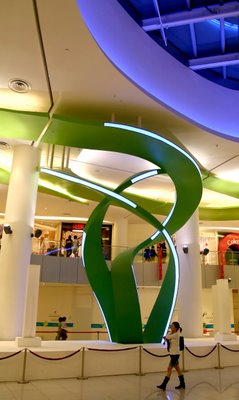
...but by no means his last (nor best, as many would opine).

attack of the killer seaweed!

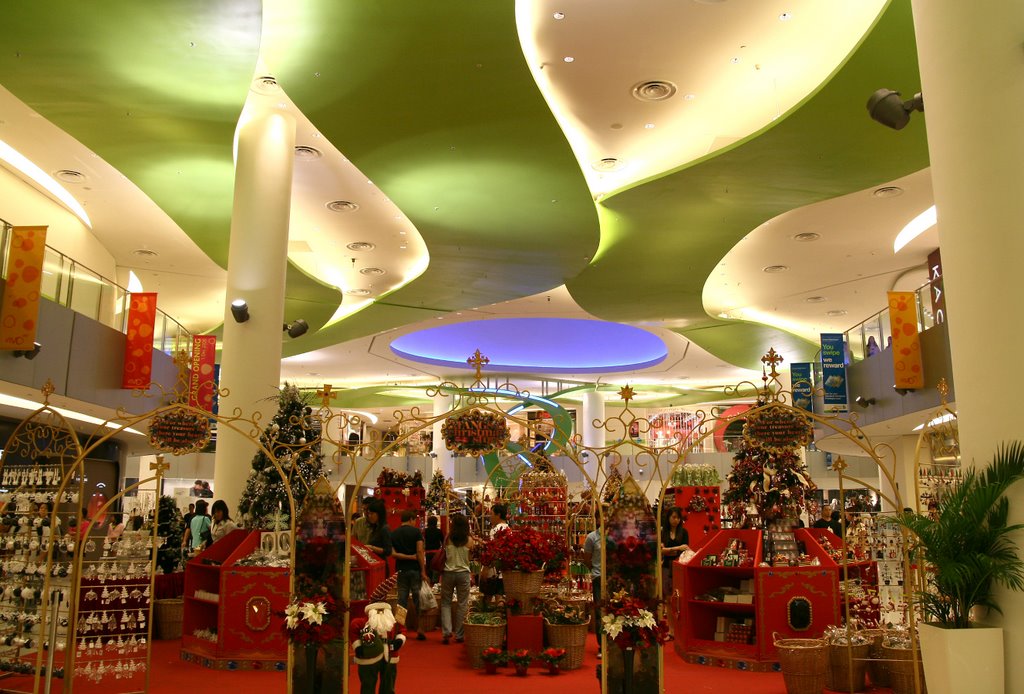
deck the halls... already?

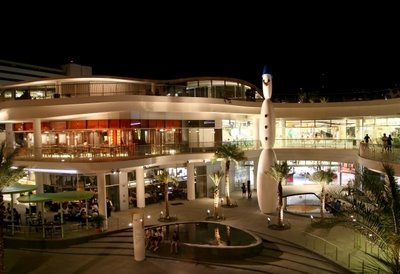
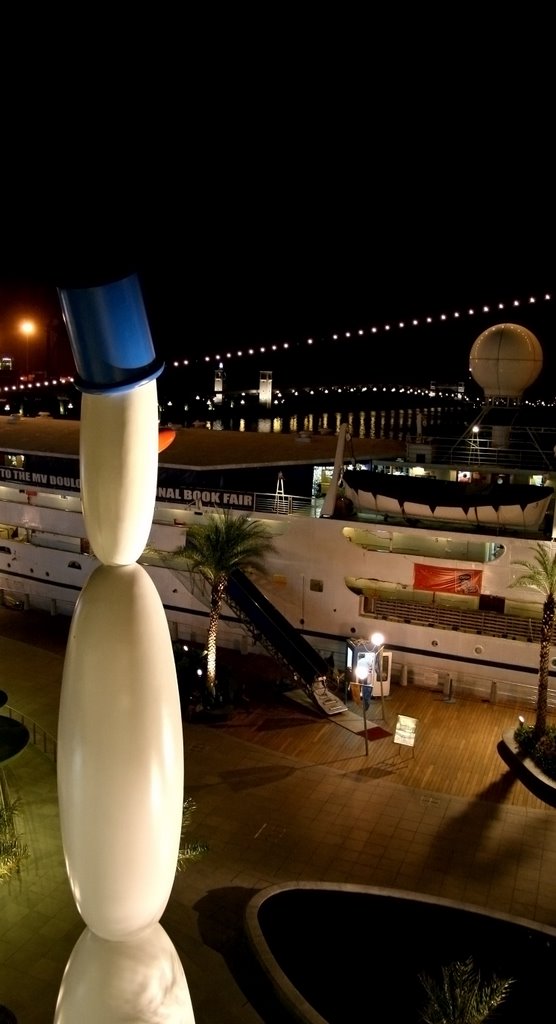
snow(man) patrol

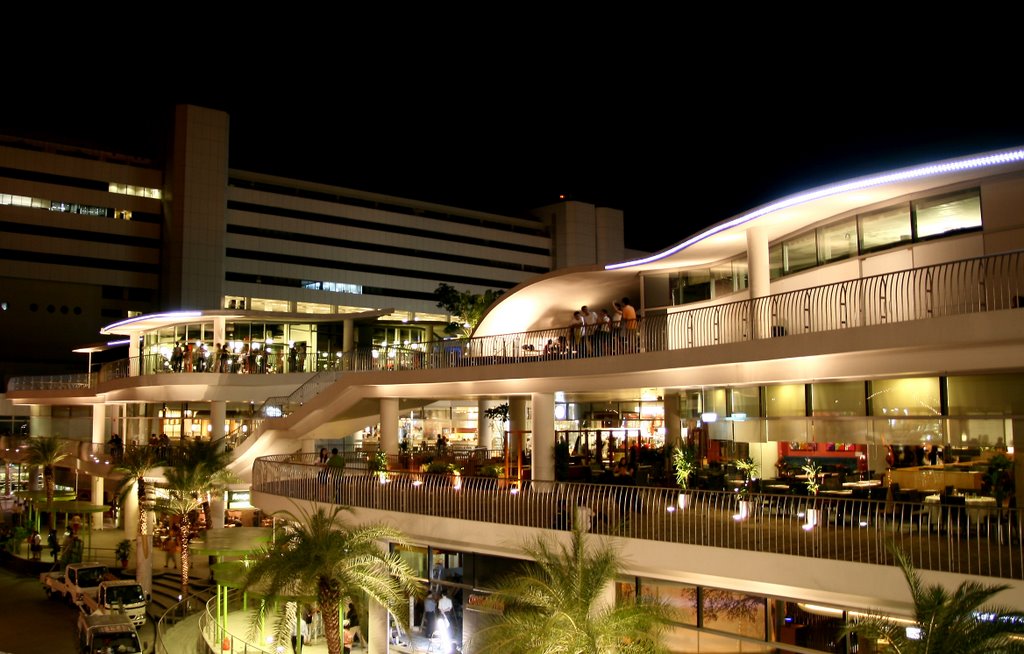
Vivocity. Could've been so much better, if not for poor workmanship, and if only they decided to use higher-grade wall putty. Still, very nice waterfront decks and roof deck. Yokohama it ain't, but it's still a pretty successful public space.

Friday, August 04, 2006

A look at the revamped Singapore History Museum

Some pix of the revamp of the dusty National Museum, done by W Architects I think. It's pretty sensitively done and you barely notice the new extension from the front.

shm6.jpg
The museum by night

shm4.jpg
Sunken corridor between the two blocks

shm3.jpg
The facade of the old block, facing the new.

shm2.jpg
The brick wall in the screening room, meant to be reminiscent of the red-brick old National Library

shm1.jpg
Detail of the bricks-- apparently the holes are for acoustic material

Friday, July 28, 2006

Toyo Ito would not be pleased

London, 2002:


Tanjong Pagar, 2006:

Sunday, July 16, 2006

Koolhaas blows a bubble


koolhaas.jpg

"...His pavilion is bigger, bolder and more expensive than any of its predecessors....Its roof is a giant, helium-filled, translucent canopy, which will rise and fall depending on weather conditions. When it is cold and windy, it will lie low; but on fine days, the cables holding it down will be loosened, and its bulbous form will rise like a balloon, higher than the gallery itself...it is essentially a joyous extravagance that stretches the definition of built form a little further."

Check out a time-lapse photo of the inflation thereof!

Read more here. More pictures here .

Saturday, July 15, 2006

building blocks!

pyramide du louvre
apple store, nyc

serpentine pavilion, london
looks like architecture's returned to its geometrical roots!

Thursday, June 22, 2006

LAST DAYS


We've come to the finale...
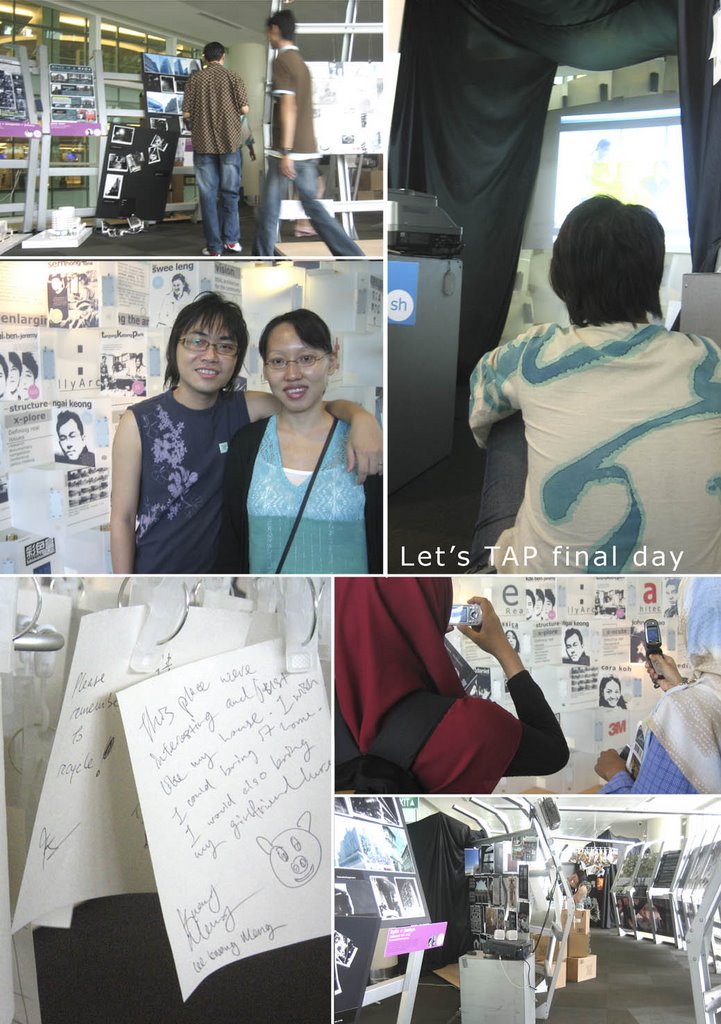
shots from the last day.

Kudos everyone!

We've come a long way...

Saturday, June 03, 2006

Late in the night- let's TAP!


Hello
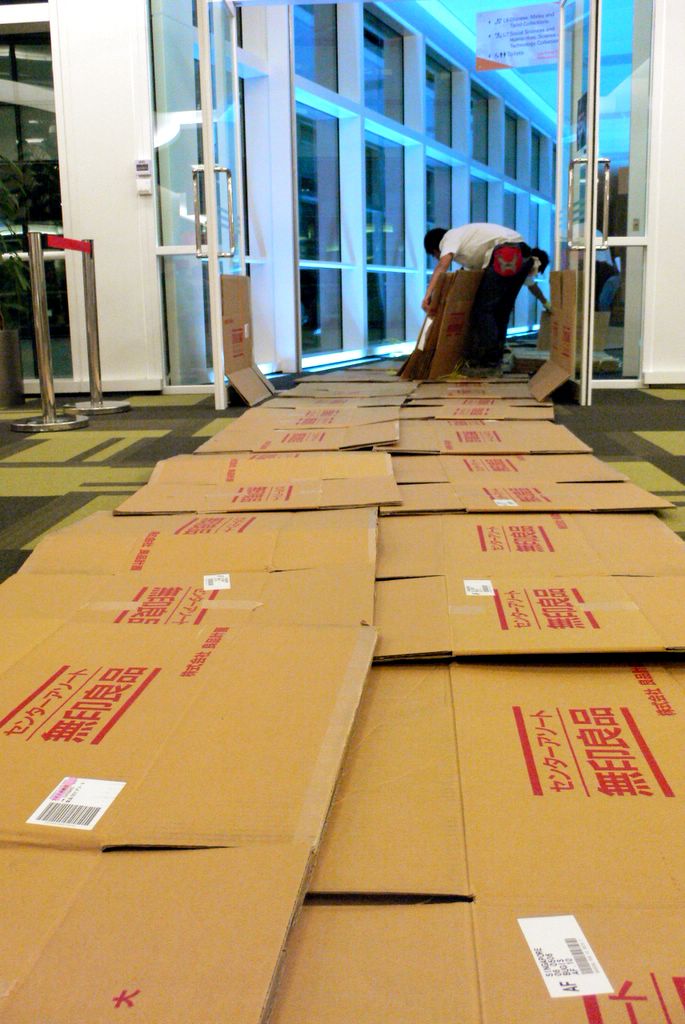
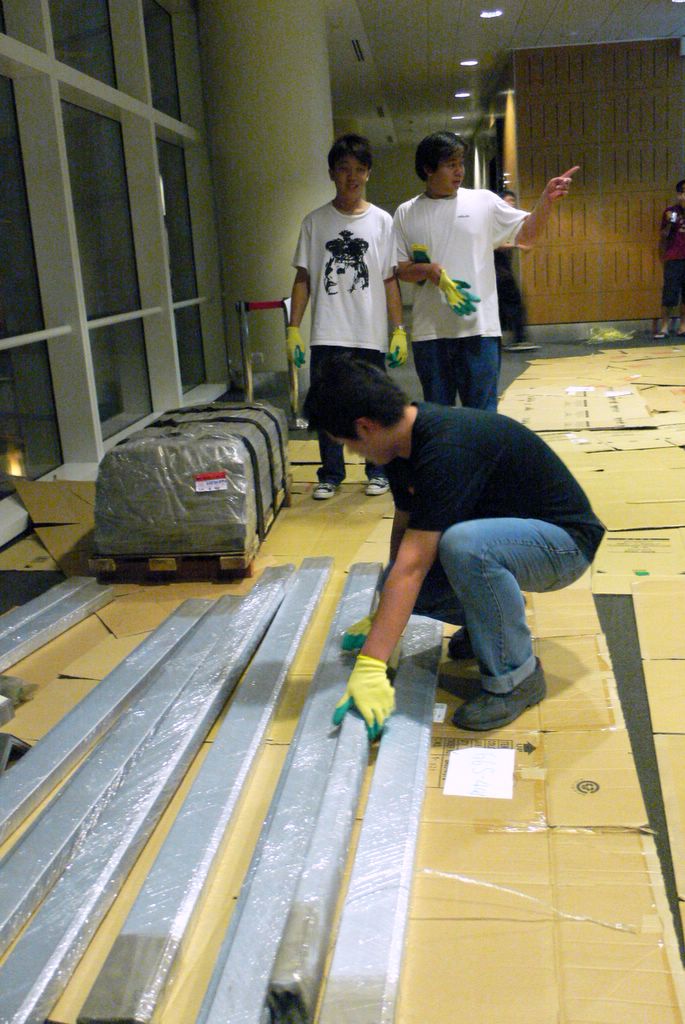
It's 2.13am now, and I have not completed my video for the exhibit! Launch is later today, and boxes of rubbish are still lying around our exhibition area.
Negativities (is there such a word?) aside, things are going pretty smoothly, albeit a little late.

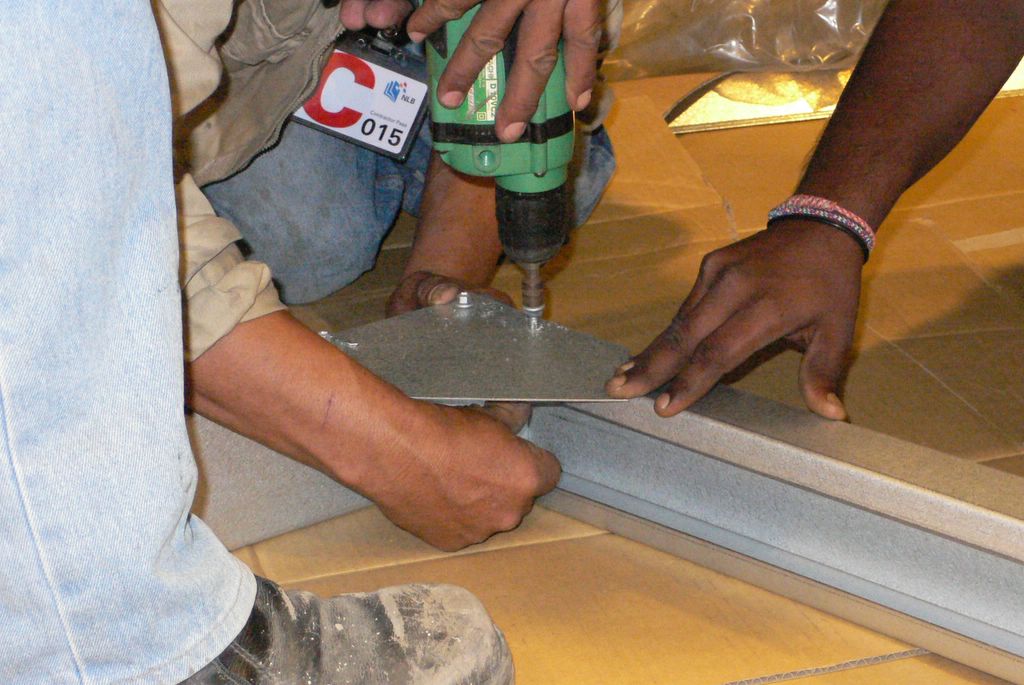
So far the exhibition is looking good. Thanks so much to all the helpers who came to help- Zitao, Aaron, Eileen, Kengsan, Xintian, Li Han, Stacy, Phang, Ong Yeun, Sin Mei, Yanting, etc. Without you guys we would not have made it. This leads me to muse on the importance of friendship. What would make one stay up so late in the night just to set up "dinasour bone" like structure? Friendship. Paste muji files together with scotch tape? Friendship. A friend comes in to help when one is in need. A big thanks Y'all!

Kudos too to Ngai Keong who has nary a 40 blinks in the last two days of setup. His unceasing energy is THE reason we've finished the structure! GOing back to the dinasour bones, that's what the librarian staff have called the thing- dinasour. Bluescope calls it the centipede, and someone commented it looks like a gym.

Come drop by to see for yourself!

Tuesday, November 15, 2005


PAST PROJECTS

Small Eyes, Big Picture Photo-Travelogue Exhibition

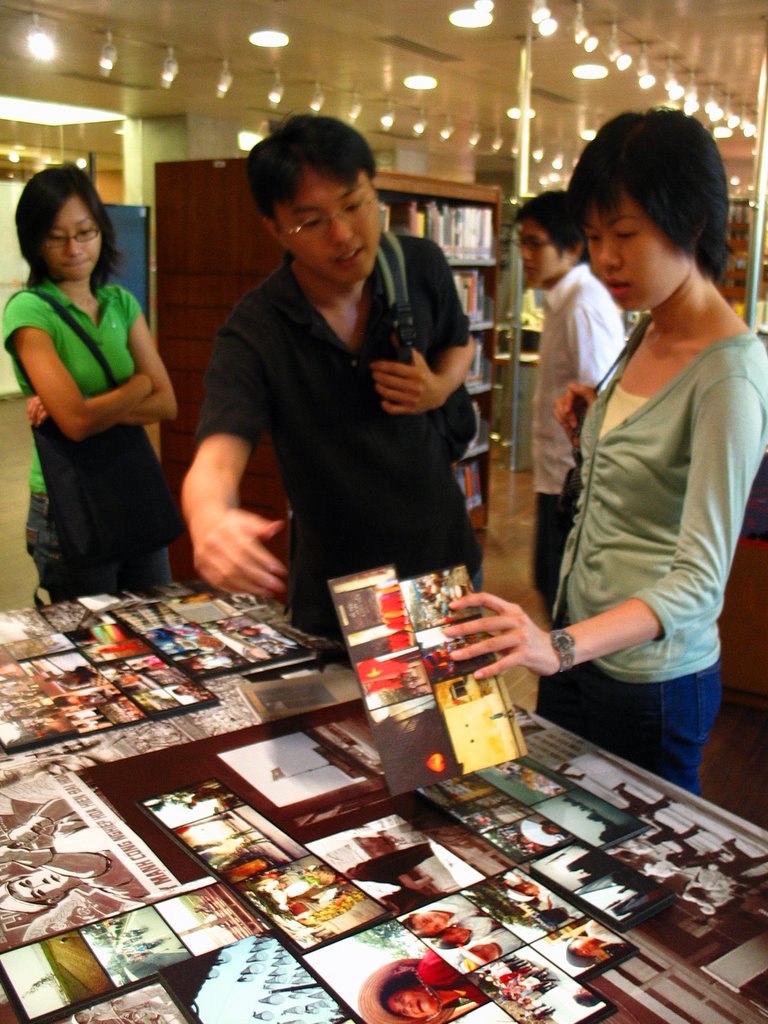
Small Eyes, Big Picture Photo-Travelogue exhibition was held at the Library@Orchard from 20th May-13th June 2005. This event was strongly supported by the National Youth Council, Singapore International Foundation, Lee Foundation, ASEANia and the National University of Singapore.

The exhibition’s moniker is a reflection on traveling- Although one’s own “smallness” is aggrandized while traveling as one is being swamped in a myriad of different cultures, people, places and experiences, traveling inevitably enlarges the traveller’s perspective on life. Showcasing Asian countries ranging from Japan, China, Cambodia, Thailand, India and Pakistan via maps, photos, videos, sketches and mementos, each traveler’s journey was exhibited in a personal way, moving beyond objective documentation to subjective interpretation. Two talks were held in the course of the exhibition in a bid to inspire other young people to have a bigger picture of life as well.


Asian Research Film

The pilot documentary on Singapore was shot and edited in May-June 2005 and presented at the modern Asian Architecture Network (mAAN) International Conference in Istanbul, Turkey in late June 2005. The documentary is a starting point in research framework meant to study the identity of Asian gateway cities while these cities are currently evolving and developing at a tremendous pace. The research framework was also submitted and published as a poster presentation in the conference. The documentary was supported by the National Youth Council, Singapore International Foundation, Lee Foundation, ASEANia and the National University of Singapore.

Akha Way Expedition + Exhibition

Akha Way Expedition (awe!) is a youth expedition project in the region of Mae Yao, Chiang Rai, Thailand, from 7 December to 24 December 2004 (18 days). The aims of this project are two fold: firstly, it is to bring awareness of local culture and difficulties faced by local hill tribes to Singapore youths, which in turn helps to raise our awareness of cultural sustainability as well as community building back in our home context; and secondly, it is to equip the locals with an income-generating tool based on eco-tourism which can contribute to a self-sustaining economy.

The expedition team is organized as an independent group, made up of 1 leader, 1 facilitator and 25 participants from various disciplines and all walks of life. The project is a collaboration between the expedition team, Singapore International Foundation (SIF) and host organization – Mirror Art Group (MAG).

The project began in early 2004, with a reconnaissance trip made in May 2004 when we met our host and gathered information for the project. Many problems are faced by the hilltribe: poverty, lack of knowledge, poor adaptation to low land living, trafficking of women and children, not able to get Thai citizenship, little job opportunities, poor health care, etc. such that it has become a vicious cycle.

Several strategies are adopted by MAG together with the villagers in overcoming some of these difficulties, one which being ecotourism. Different from the tourist industry that has already taken place at other regions run by external commercial groups, the idea here is to empower the villagers so that they can be self-sufficient in managing the tourist industry themselves as a way of income generation. In a way, this can also boost their confidence in preserving their culture and environment and presenting them to the outside worlds.

The definition of eco-tourism is thus unique in this case, i.e. the social aspects has become the main driving force for its sustainability, while nature and environmental aspects assuming a supporting role. As such, the expedition project aims to provide an understanding to the various social and cultural significance of the region, juxtaposed with the interest in nature, through the exercise of information gathering, planning, designing and finally delivering the outcome as a form of knowledge.

The expedition basically involves two primary projects: an ecotourism site survey for a group of villages in Mae Yao sub-district using Global Positioning System (GPS), and the building of a small-scale information centre at an Akha hilltribe village - Ban Apa. Through these projects Singapore youths collaborated with the local community and host organization in delivering both the information and the infrastructure that can serve as a reference to the development of ecotourism in this area. Through information gathering, planning and designing, the participants acquired greater awareness of the local culture and environment, while the actual expedition had provided them with first-hand experience in working and living (home-stay) with local community.

As a continuation of our efforts in promoting the awareness of the regional culture as well as sustainability, an exhibition was held in September 2005 (three weeks) at the National Library in Orchard. Through this exhibition we hoped to raise the awareness of minority culture in this region – their lives, beliefs, struggles with modernization, etc., by sharing what we have learnt during the expedition. We would also like to promote ecotourism as an alternative way of traveling – a life-transforming experience that the travelers will be truly exposed to the authenticity of cultural and natural environment by living the way the local live. It is believed that with the income generated from this self-managed industry, the locals will be able to sustain their way of life without subscribing to modern lifestyles totally. Finally, we wish to share our ideas in sustainability of culture, such as in the case of architecture, through re-interpreting their culture and use of local materials. In a way, this has also brought some reflections on the sustainability of our own culture.