London, 2002:
Tanjong Pagar, 2006: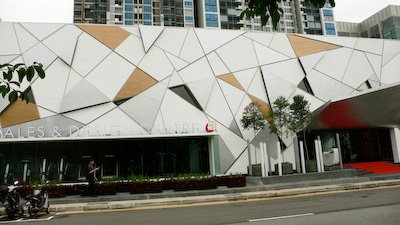
Friday, July 28, 2006


Sunday, July 16, 2006
Koolhaas blows a bubble
"...His pavilion is bigger, bolder and more expensive than any of its predecessors....Its roof is a giant, helium-filled, translucent canopy, which will rise and fall depending on weather conditions. When it is cold and windy, it will lie low; but on fine days, the cables holding it down will be loosened, and its bulbous form will rise like a balloon, higher than the gallery itself...it is essentially a joyous extravagance that stretches the definition of built form a little further."
Check out a time-lapse photo of the inflation thereof!
Read more here. More pictures here .


Saturday, July 15, 2006
AA projects review + Cooper Union show + NUS arch show
This might save you a few bucks from buying the AA Projects Review soft-cover:
http://www.aaschool.ac.uk/aadvd/
Nifty web design, images a tad too small to really appreciate the work - comes off as a fancy pictureshow, and looks just about the same thing to any Projects Review from the past. (Dare I say I like the past Projects Reviews much better.)
Some images of work from Cooper Union's arch school below - hadn't seen much of their stuff since one of the early Education of an Architect books - so dropped by their end-of-year show a few weeks ago: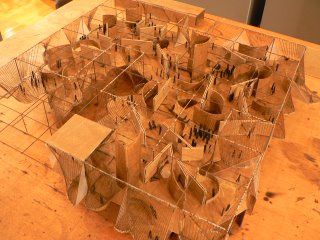
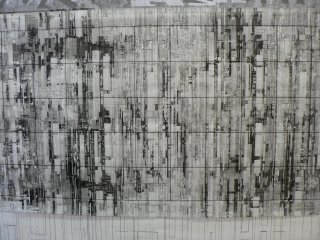
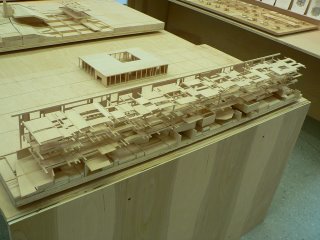
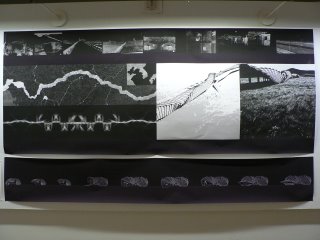
Some nice work, if not for the fact that everyone's models were in monotone wood, looked like every single project was done by the same person! (I love wood models though.)
Putting things in perspective (kinda), here're some images of work from the NUS arch show:
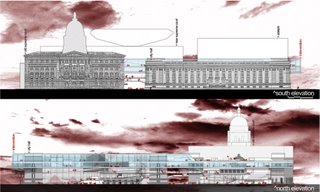
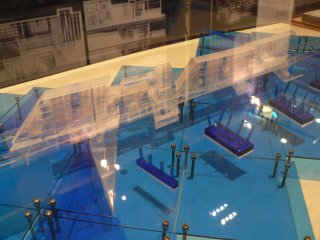

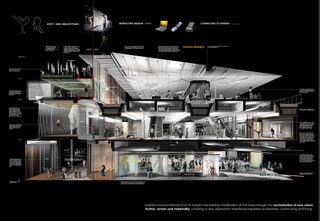
Will we ever get something that bridges between high concept and buildability, yet breaks new ground and is socially-conscious?
building blocks!
 pyramide du louvre
 apple store, nyc
 serpentine pavilion, london
looks like architecture's returned to its geometrical roots!
Report: Let’s Tap – Architect in A Bottle
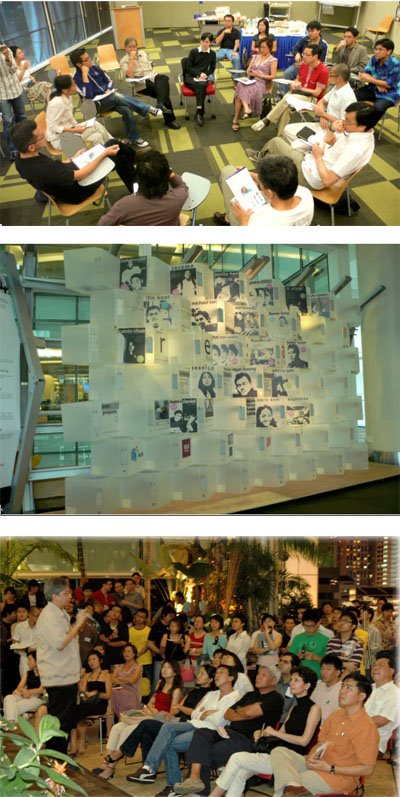 Report: Let’s Tap – Architect in A Bottle Reported by: Soh Lin Li
Can architects mould a nation?
This question never occurred in my mind till it was brought up during the Up Close & Personal pre-session of the Forum: Architect in A Bottle held on the afternoon of 10th June in the Imagination Room, just hours before the actual Forum, held in at the Level 5 Courtyard.
The forum was organized by the ReallyArchitecture [re:act], comprising architectural students, professionals and individuals interested in architecture. The aim of the forum was to encourage exchange and greater discourse between the architectural community and folks from all walks of life to create a greater awareness of the role of architecture in the everyday. It was to be a heated forum in more ways than one, amidst the beautiful backdrop of the Courtyard, nicely decorated with white roses blending with the lush foliage. Made complete with beautiful mood music and warm lighting, the courtyard was packed with 167 attendees, waiting in turn to ask the panel about the influence of architecture in their lives.
The panel was made up of Dr Edward Ng, Dr Johannes Widodo and Mr Chu Lik Ren. Dr Edward Ng is an Architecture Professor at the Chinese University of Hong Kong, and an environmental consultant offering expert services to organizations and governments. His design works have been exhibited in the UK, Germany, Hong Kong and Singapore. Recently his “A Bridge Too Far” project received a “highly commended” recognition from AR, and it also won the 2006 HKIA Project Outside HK Award. Dr Johannes Widodo is an Architecture lecturer with a joint appointment as Research Leader in Asian Cities Cluster to Asia Research Institute (ARI) at the National University of Singapore. His area of specialization includes architecture, urban history and morphology of Southeast Asian cities, Asian modernity, and heritage conservation. Mr Chu Lik Ren is an Architecture lecturer at the Singapore Polytechnic. In 2004, he was one of the 20 young architects featured in URA’s “20 Under 45” exhibition.
Mr Colin Seah, who is the principal architect of the Ministry of Design, Singapore, moderated the panel discussion and Ms Gee Miaw Miin, Manager of Lee Kong Chian Reference Library, opened the session. The forum covered issues such as the re-definition of the architect’s roles, the influence of commercialization on architectural designs, HDB as the biggest community architect in Singapore, and community projects. Issues related to the Exhibition: Let’s Tap, such as the definition of space we want to live in, and reviving the memories and histories of architecture being abandoned by its inhabitants were discussed at the forum too.
The exhibitors of the Exhibition: Let’s Tap, which ran from the 3rd to 17th June at the level 8 Promenade, were also invited to the Pre-Session of the Forum, held in a Up Close and Personal round-table discussion format with the panelists. The objective of this round-table discussion was to provide a platform for interested parties to interact with the speakers on a more intimate level. Members of the Singapore Institute of Architects were invited for this intimate interaction and special guests included Pioneer Architect Mr Tay Kheng Soon, who is the Adjunct Professor of Architecture at the National University of Singapore. Mr Gene Tan, Deputy Director of INVENT, facilitated the session. The session kicked off with a discussion on the architecture of the National Library Building, and views were bandied around amongst the participants. One of the points raised was that the blueprint of the building should be documented and archived in NLB’s collections, including the architectural drawings of the other libraries.
The evolution of library buildings and usages were discussed and many felt that libraries these days have become more user-centric than books-centric. Some participants also felt that the design of the National Library has to address issues of being a research centre and a public space, albeit with Singaporean attributes. Finally the question was thrown to the floor: Do architects think that they can change the world or shape a nation? Just like the great poets in past epochs who generated emotional content crucial to the formation of a nation, the shared sentiment was that the architect does have a role in the making of a place, a nation.
Thursday, June 22, 2006
LAST DAYS
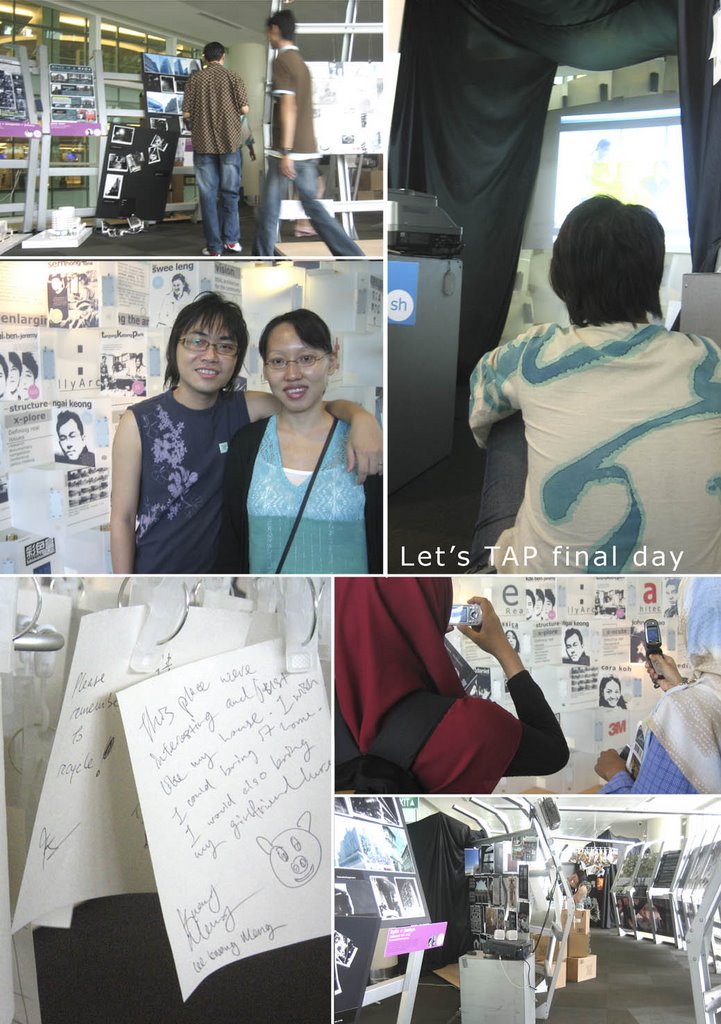
We've come to the finale...
shots from the last day.
Kudos everyone!
We've come a long way...
Saturday, June 03, 2006
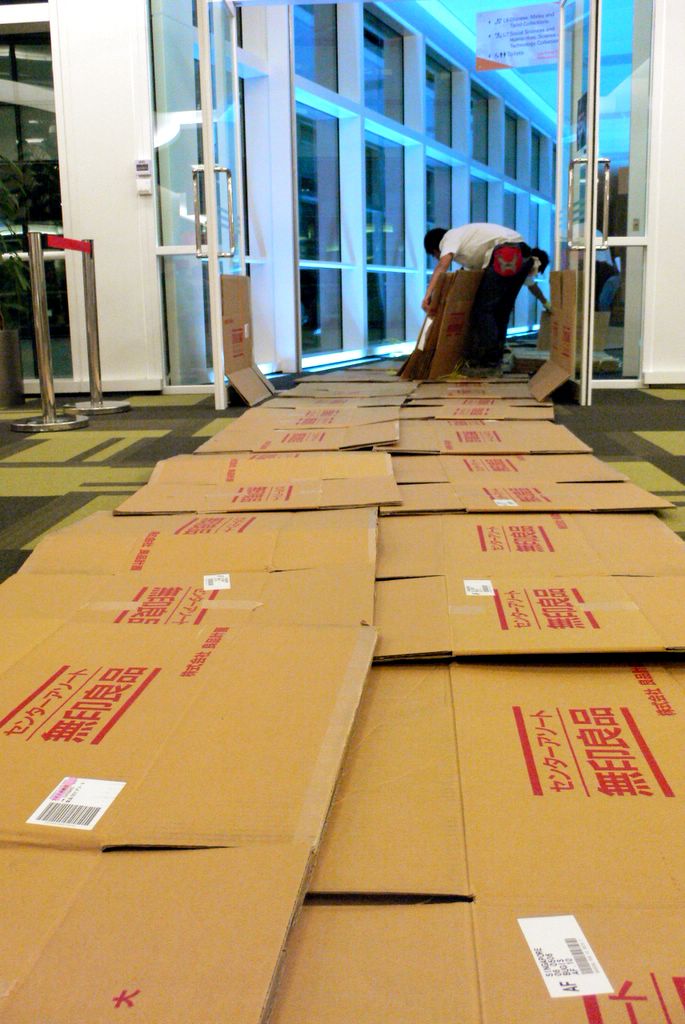
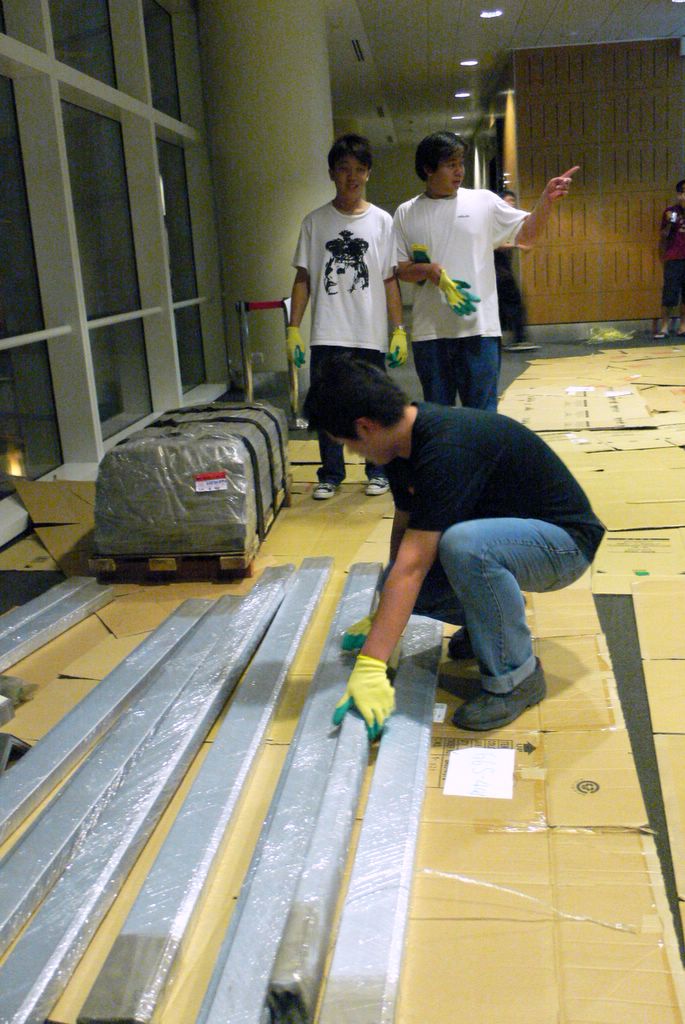
Late in the night- let's TAP!


Hello
It's 2.13am now, and I have not completed my video for the exhibit! Launch is later today, and boxes of rubbish are still lying around our exhibition area.
Negativities (is there such a word?) aside, things are going pretty smoothly, albeit a little late.
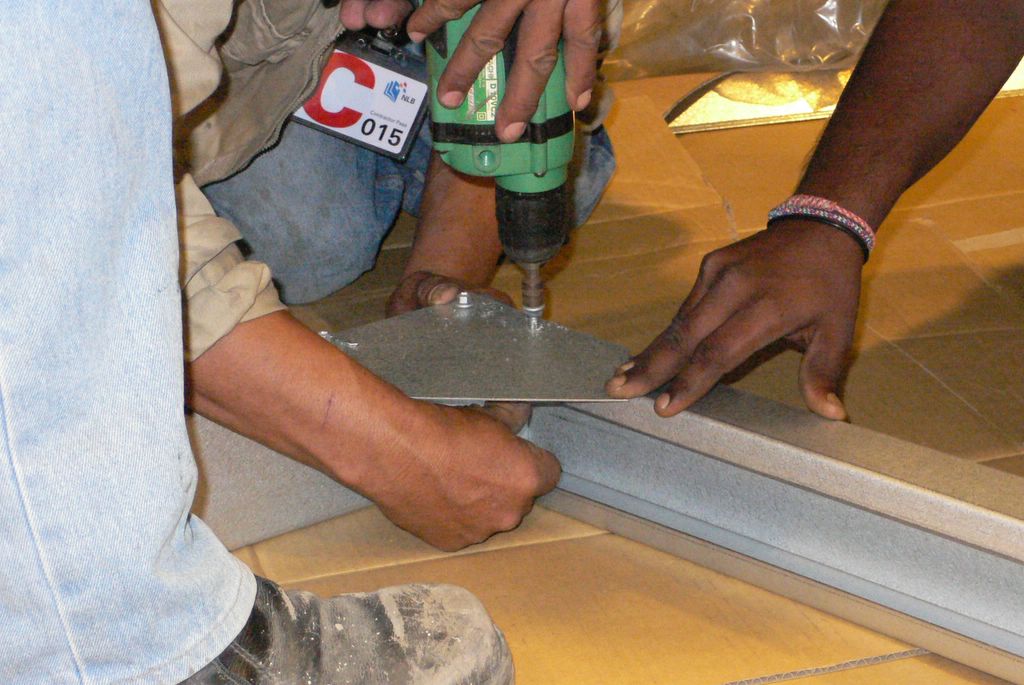
So far the exhibition is looking good. Thanks so much to all the helpers who came to help- Zitao, Aaron, Eileen, Kengsan, Xintian, Li Han, Stacy, Phang, Ong Yeun, Sin Mei, Yanting, etc. Without you guys we would not have made it. This leads me to muse on the importance of friendship. What would make one stay up so late in the night just to set up "dinasour bone" like structure? Friendship. Paste muji files together with scotch tape? Friendship. A friend comes in to help when one is in need. A big thanks Y'all!
Kudos too to Ngai Keong who has nary a 40 blinks in the last two days of setup. His unceasing energy is THE reason we've finished the structure! GOing back to the dinasour bones, that's what the librarian staff have called the thing- dinasour. Bluescope calls it the centipede, and someone commented it looks like a gym.
Come drop by to see for yourself!
Saturday, April 29, 2006
Urban Typhoon Workshop @ Shimokitazawa, Tokyo
Urban Typhoon Workshop
Shimokitazawa, Tokyo
We invite creative spirits from Japan and abroad to brainstorm on the present and future of Shimokitazawa, at a time when the government is planning a 26 meter-wide road cutting through its culturally vibrant streets.Shimokitazawa, Tokyo
The Urban Typhoon workshop is a global experiment in participatory design. It is directly connected to the various subcultures of Shimokitazawa and its grassroots community groups.......
The workshop has various areas of concentration and modes of intervention, including: architecture & design studios, art installations, political café, oral history, graphic communication, video, etc.......
The objective is to produce alternatives to the government's plan as well as a multimedia testimony to the unique spirit of Shimokitazawa. The workshop itself is a joyous and participatory takeover of the city.
The Urban Typhoon Workshop is connected to 2 other events:
1) Urban Design & Ubiquitous Society Symposium, June 28, 2006:
Special event organized by the Interdisciplinary Institute of Information Studies at the University of Tokyo. This symposium will investigate the potential of ubiquitous information technology for architecture and urban planning based on citizen participation.
2) Cultural Typhoon Symposium, June 30 – July 2, 2006:
Annual inter-university event attended by hundreds of scholars from Japan and the rest of the world. This year Cultural Typhoon takes place in Shimokitazawa and focuses on the theme of urban culture. The outcome of the Urban Typhoon workshop will be presented and discussed during the Symposium.
See http://www.cultural-typhoon.org
Friday, March 31, 2006
MUJI!
Update on Let's TAP exhibition, June 2006.
MUJI's gonna be our sponsor!
And you think dreams don't come true...
Wednesday, March 29, 2006
Concept of Home
newpaper article SEPT 1 2002
My country, but not my home?
------------------------------------------------------------------------
Richard Lim
In today's decentered, plug-and-play world, is home an outdated notion? Isn't one rooted to ideas, rather than to places? Why be a citizen of a small place, when one can be a global citizen?
'SINCE I was 14,' she says, 'I lived my life as a stray cat.
Global citizens who live outside their countries, and those who have no choice but to live in their countries but who refuse to make a commitment - they may soon become the norm rather than the aberration. -- ALAN LIM
'Whoever gave me warmth became my instant family and my home. So I guess I don't have any attachment to one country where I can call my real home.'
'But,' my Japanese friend adds, 'there is one thing that has kept me rooted. It's the aesthetic sense and morals that were repeatedly taught at home and at schools.
'Now, no matter where I am, I cannot get rid of a certain sense of responsibility. I feel as if I were a representative of my country. It's a bit stressful, but I guess it keeps me from mischief.'
My friend has had her fair share of mischief. In her days as a stray cat, she had drunk too much, and partied too much. But now in her late 30s, and married with two children, she's a proper professional and a dutiful wife.
A Kobe native, she had her university education in Tokyo, then went across to the United States to do further studies. She had worked in Japan, Hongkong and Kuala Lumpur before coming to Singapore last year, after her Malaysian husband was posted here by his employers to head their regional office.
She confesses though that she still has no place to call 'home'.
'But in a sense I'm lucky, because I can feel at home anywhere,' she says.
'No matter where I am, in Singapore, in Kuala Lumpur, in Hongkong, in the US, or even in an airplane, the moment I hear the good old Kansai accent, that space becomes my instant home.'
Where would you want to retire, I ask her.
'Oh, you know I don't plan to live long. But if I could afford it, I'll spend spring, the season of the sakura, in Japan; and summer till autumn, when the leaves change colour, in Paris; and winter in a tropical place like Singapore,' she replies.
'I don't want to be committed to one country. I'll get terribly bored.'
She's your prototypical global citizen in today's decentered, plug-and-play world.
One in four people on this tiny island are not Singapore citizens, and probably one in eight young Singaporeans see themselves as transient as they are (although actually, a not insignificant number out of every wave of foreigners who come through will choose to settle here).
They may invest in property and equities, but they certainly are not rushing to make emotional investment in the country.
Global citizens who live outside their countries, and those who have no choice but to live in their countries but who refuse to make a commitment - they may soon become the norm rather than the aberration, what with the world becoming one connected playground and workplace.
With such a world, there can be no geographical centre. There are, instead, scattered nodules competing for people's attention.
'New York, Warsaw, Tehran, Tokyo, Kabul - they all make claims on our imaginations, all remind us that in a decentered world we are always simultaneously in the centre and on the periphery, that every competing centre makes us marginal.'
This, according to Eva Hoffman, the Polish emigre who made good in the United States, in her 1989 book, Lost In Translation: Life In A New Language.
How to resolve her bivalence? Be here now, is her answer.
'I am the sum of my languages - the language of my family and childhood, and education and friendship, and love, and the larger, changing world,' she declares.
But after finishing her next book, Exit Into History (1993), a chronicle of her journey through the newly opened Eastern Europe, which was recorded with the eyes of an outsider and the love of a native daughter, she chose to leave New York where she worked as an editor of the New York Times Book Review to set up home in Cracow, Poland.
She may have made a choice, a commitment, in the end.
To be ambivalent, to be committed to no particular place, may be to suffer what the exiled Czech writer Milan Kundera has famously called the unbearable lightness of being. How can one take oneself and one's endeavours seriously?
Of course, the Salman Rushdies of this world will retort, if rather fancifully: 'One of the effects of mass migration has been the creation of radical new types of human beings: of people who root themselves in ideas rather than places, in memories as much as in material things ... people in whose deepest selves strange fusions occur, unprecedented unions between what they were and where they find themselves.'
But go back one generation, and you had a V.S. Naipaul lamenting, after having been transplanted from the West Indies to England for eight years:
'I find I have, without effort, achieved the Buddhist ideal of non-attachment. I am never disturbed by national or international issues. I do not sign petitions. I do not vote. I do not march. And I never cease to feel that this lack of interest is all wrong.
'I want to be involved, to be touched by some of the prevailing anger.'
My friend and one-time mentor, the Malacca-born poet Shirley Lim, who has spent almost all her adult years in the US, records in her memoir, Among The White Moon Faces (1996):
'Everywhere I have lived in the United States - Boston, Brooklyn, Westchester - I felt an absence of place, myself absent in America.'
Of her frequent returns to this part of the world, she says: 'Returning, I am filled with an ineffable sense of completion, a satiety of recognitions. No matter how urgent my struggles to escape childhood poverty and the country's racial politics, I have continued to feel an abiding identity with Malaysia's soil.'
My Japanese friend may say she doesn't want to be committed to any one country. But on the other hand, she admits she feels responsible as a representative of her native country.
That can be stressful, as she has pointed out, but it sure is better for the soul than to be floating weightlessly through an endless multiplicity of events and places.
Living a day at a time, plug and play, easy come, easy go, and to be comfortably numb - that's not being a radically new type of human being. That's being a cop-out.
To be a citizen of the world is to be an orphan in a free state with no stakes and no responsibilities. But that free state is not real, because it is nowhere land.
Call me an old geezer, a stick in the mud, but I'm persuaded that one needs a home, and in that home, one finds meaning in others who share it, and tries to mean something to them as well.
Subscribe to:
Posts (Atom)