Thursday, January 11, 2007

Cities' Systems & Geopolitics : suggested readings

(The website didn't allow me to post this under the comments thread of Sernhong's post so I'm putting it here as a separate post. So here it is)

To Sernhong and all out there who are interested:

I'm not sure if you're interested in pursuing further relevant reading. There are already a series of academic writings out there that exist on the same themes you mentioned in your blog post, but rooted in Singapore, SEA and East Asia. (some of them written by NUS academics, no less!)

1. Theorizing the Southeast Asian City as text : Urban landscapes, cultural documents and interpretive experiences (edited by Brenda Yeoh and Robbie Goh)
2. Postcolonial Urbanism (edited by Ryan Bishop, Yeo Wei Wei, Robbie Goh. Has many articles focussing on Singapore. I especially like the one by Shirley Geok-Lin Lim.)
3. Hong Kong: Culture and the Politics of Disappearance (by Ackbar Abbas, who writes about HK imagination, not unlike how Walter Benjamin writes about Paris)
4. East Asia Modern: Shaping the Contemporary City (by Peter G. Rowe, former chair of architecture, Harvard GSD)

Also, the idea of multiple global/regional networks (e.g. trade network systems vs aristocratic central placement systems) influencing the patterns of urban development is not new, and has been in effect as early as the Baroque age or even earlier. For this history in a European context, read

5. The Making of Urban Europe : 1000-1994 (by Paul Hohenberg & Lynn Lees)

On the radical effects of globalisation on instituting networks of culture (e.g. mediascapes, ideoscapes, financescapes, ethnoscapes, etc), read

6. Modernity at Large: Cultural Dimensions of Globalization (by Arjun Appadurai, globalisation theorist)

You might also want to follow the ideas and readings of scholar Manuel DeLanda, who specialises in the theory of self-organisation in cities.

William Lim also writes extensively on his New Asian Urbanism (i.e. the same issues rooted in an Asian context), theorising on the collective unconscious that influence the development/energy of cities like Bangkok, Shanghai and Hong Kong.

Hope that wasn't too overwhelming.

Best
Ronald

Wednesday, January 10, 2007

Cities' Systems & Geopolitics

Yoz! Sernhong here. A very Happy New Year to everyone! Its been a while since I have put up any blog entries. ReallyArchitecture [react] just had an AGM 2 weeks ago, a successful one that managed to overcome the geographical boundary problem which we fear yet embrace at the same time. Kudos to the inventor of the Internet! All of us from Singapore, Los Angeles, New York & London met online for a video conference and had a meaningful and fruitful 3-hr meeting session!!! We all look forward to a fruitful and adventurous time ahead.

The Spring semester just started for me here at SCIArc. In Wes Jones's studio now. Since the blog also serves as a way for each of us to share our experiences and architecture education, I am putting up a series of stuff which I have come across, as well as stuff which I have done. I hope they will be beneficial to you as they have been to me. The topics/issues range from architecture digital intelligence to urban strategies and political empowerment. Hopefully, these can stir up a dialogue among ourselves to think about the following: the definition of ’the architect’, the architect’s role, architecture & practice, relevance to society, impact of intervention & individual’s purpose as an architect. Feel free to comment.

The 1st of the ‘series’ is an extraction of a seminar brief by this
media-artist-cum-architect-cum-film-maker called Ed Keller. You can check out his office’s website www.aumstudio.org. This semester he wants to push everyone to possibly come up with a manifesto from the studio work. The stuff he is looking at got to do with Geopolitical issues, Power of the city, 21st century borders, city morphologies, tipping point of each city, etc.

Here goes >>>

Scenes from Syriana (top) & Code 46 (bottom)


City Systems

(Below is an extraction from the Post-Empire Urbanisms course description, by Ed Keller)

Cities have historically functioned as ‘ambient’ environments, with many cultural, economic, political and aesthetic systems inflecting each other and creating complex urban ecosystems with lifespans in the centuries. The city comes to life through the overlapping ambiences it can host: either as a kind of software, in cultural movements, or a kind of hardware, in the physical forms of the architecture of the city itself. The unique nature and identity of any urban location emerges in an irreducible resonance that is produced between that ‘software’ and ‘hardware’. In the case of the contemporary global city, the intensification of this relationship has produced a more radical set of bifurcations, no longer resolved as the outcome of a binary logic (‘ambience’), yet rather as a monolithic temporal construct of parallel realities.

… … Design of the city now has to ask how we can harness globally networked systems of capital, transnational entities, and technologically enabled relationships and use them to energize the city.

… … Today’s development of Geotagging, locative media systems and the like are symptomatic of a new genre of representation and communication that will radically transform the city. Likewise, a new paradigm in both theory and narrative [written and filmed] provides us with glimpses of parallel realities which function as futures that we can anticipate with a mixture of dread and delight … … The global spaces of contestation for resources, identity, infrastructure, military control, or desire that we see in films like Demonlover [Assayas,2003], Syriana [Gaghan,2005], or Code 46 [Winterbottom, 2003] are not science fiction speculations, but verifications of the wildly reterritorialized reality we inhabit today.

… … The ‘time’ of the institution, which organizes a kind of monolithic memory structure on a political and cultural level – contrasts dramatically with the time of the individual subject, which is filled with myriad unpredictable details … … Urban morphologies are now on fast forward, as they adjust ever more rapidly to global systems that provide individuals, collectives, institutions with constantly shifting ways to interact. Architecture operates as a key link in this dynamic relation, in its capability to slow down such time, unlike many other disciplines tied into the practice of generating urban morphology. This seminar will study these emerging ‘Post-Empire’ landscapes of control, systemic tendencies, and new freedoms.

Well, I am taking this seminar to aid in my thesis(summer 2007) and trying to relate to how the morphology of not just Singapore, but Asian cities, particularly East Asia and South-east Asia, have developed and how it can potentially develop if we can understand them more and get a grip on the ‘systems’ in the midst of globalization. Personally, I feel a slow but sure subtle displacement of the architect’s role in the development of cities’ morphology. It also brings us back to the issues we discussed during the ‘Architect in a Bottle’ forum in June 2006. As Sylyng might agree, these also will link to what we have in mind for the theme content of the REACT’s newsletter, now in its 4th draft review.


A Tale of Two Cities - Part 1


Singapore is a city on the brink of adulthood. Like many cities undergoing this stage of maturation, Singapore has an insecurity-complex fuelled by the need to prove that it “has arrived” in the league of big cities. In view of this observation, I thought it appropriate to draw an analogy from a different moment in the history of a different city, one that Singapore likes to compare itself to: New York.

Compared to most European cities, New York is much younger. (hardly two centuries older than modern Singapore) Much of New York’s development was driven by maritime trade and industry, the primary source of its wealth. As can be imagined, much of New York’s initial growth was haphazard until the 1811 grid plan. It wasn’t until the early to mid-1800s that a class of wealthy Americans emerged, thanks to trade money. New York had no aristocratic wealth to speak of.

Members of this new leisure class were able to afford their grand tours of Europe. They went to the historic and cultural centres in Europe and saw in these cities what their own did not have: art and culture, grand museums, palaces, public parks, libraries, concert halls, and modern underground railroads, etc. It is this insecurity-complex, this need to be as great as Paris or London or Rome, that led to the creation of institutions and buildings like the Metropolitan Museum of Art, Central Park, The New York Public Library, Grand Central Station, etc.

Most of you probably find this tale familiar. After 40 years of economic prosperity, many of us have travelled and seen some part of the world to feel that we must have our Guggenheim Bilbao (Marina Bay IR), our waterfront performing arts centre (Esplanade), our museum in an imperial classical building (the old Supreme Court / new National Art Gallery), our London Eye (Singapore Flyer), our Central Park (“Central Linear Park” in the new Marina downtown) and our hi-rise Manhattan lifestyle (the new Marina downtown).

These developments have as much potential to make Singapore a richer and more exciting place, as they have the potential to sap up and displace all that is authentically Singaporean. When we desire to be world-class, we desire to enter a “class” whose standards are pre-determined by others, not by us. This implies that the others who set the standards of “world-class” are better than us. It also implies that we do not sufficiently trust our authentic selves to manifest externally.

As opposed to being world-class, I much rather we be in a class of our own. Instead of aspiring to be the “New York or London” of Asia, would we have the courage to be the “Singapore of the world?" What would that entail? That is when we can finally use our imagination, and stop playing catch-up.

(Part 2 will focus on Architecture. Specifically, I will attempt to compare the proliferation of neo-Modern design aesthetics in Singapore today [as a symbol of good taste] with the proliferation of neo-classical beaux-arts architecture in New York from 1800s through the early 1900s)

Tuesday, January 09, 2007

SPUR - Singapore Planning and Urban Research Group


Selfish me almost does not want to share this discovery. (Since I want to be able to return to Singapore to get my own copy.) Select Books still has a few copies of the 2 original SPUR publications: SPUR 65-67 and SPUR 68-71 for sale. They are selling for S$47.62. Click on the links for the online shopping webpage for both journals.

Secondly, I found an interview transcript of Philip Bay interviewing Tay Kheng Soon (transcribed by Dinesh Naidu) on the trials and tribulations of SPUR, coloured with political dimensions and personalities of that nation-building era. I found it a very refreshing departure from the story of SPUR that most of us are familiar with. It is definitely very thought-provoking, in view of the paths we are beginning to embark on. So here are the links.
Tay Kheng Soon & SPUR (Part 1)
Tay Kheng Soon & SPUR (Part 2)

From this, one learns that architecture is never entirely separate from politics.

Sunday, January 07, 2007

The Will of the Epoch , The Spirit of the Age

Ludwig Mies van der Rohe once commented that architecture is “the will of the epoch translated into space”. His mentor Peter Behrens (and also mentor to Gropius and Corbusier) made a similar Zeitgeist argument : that architecture needed to embody the “Spirit of the Age”. Corbusier revisited the same theme when he insisted that the Machine Age demanded a new Machine aesthetic. All three were convinced of the inappropriateness of the beaux-arts approach and concerned with how architecture should accurately represent its day and age. [click on link for wikipedia entries on "Peter Behrens" and "Zeitgeist"]

Throughout the ages, the production architecture has been inextricably linked to the culture that was its setting. Gothic cathedrals were earthly manifestations of divine perfection of heaven for Medieval city-states. The mathematical precision of perspectival urban axes during the Renaissance was yet another manifestation of this divine order for a different age of absolute reason and knowledge. Mies and Corbusier were fascinated with the new technologies availed by the Industrial Revolution.

Perhaps with the same predictability, one observes the very same phenomenon today, with the proliferation of digital technologies, powerful computer modelling tools and daring computer-generated forms produced by Asymptote Architecture and Zaha Hadid. I find myself at once awed and, yet, unconvinced by today’s expressions of our digital-age. I therefore pose this question, “Is this digital-computer-internet age the will of our epoch?” If not, then “what is the will of our epoch?”

Ironically, this question is at once relevant and irrelevant. Indeed, the trajectory of history has progressed to an extent that our digital age of sophisticated technologies is a far cry from that medieval era centuries ago. Yet, both ages were inhabited by homo-sapiens. They had eyes, hands, and feet, enjoyed music and human pleasures like sex. Socio-cultural practices notwithstanding, they each carried a soul, a will, and capacities for emotion and complex reasoning. Across the ages, the human spirit has remained universal.

The same overwhelming emotion of experiencing the light entering through the oculus in the Rome’s Pantheon touches the inner core of today’s jet-setting tourist as it did the inhabitants of Rome centuries ago. The same lines from a Shakespearean play incited the same emotional intensity of Globe Theatre patrons 400 years ago as they continue to do to many today. Similarly, that “ineffable space” in Corbusier’s Ronchamp cathedral touched the deep unconscious core of visitors then, as it continues to do to architectural pilgrims to this day. [click on link for images]

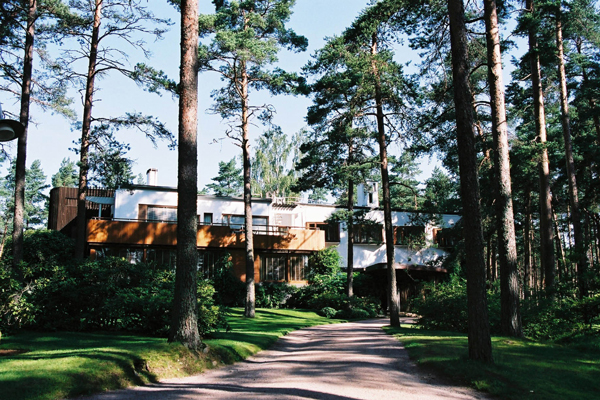
At this point, that I realise that there are two (and possibly more) poles pulling architecture (and myself) toward different directions. On one extreme is our location in the trajectory of history and “the spirit of our age,” and on the other extreme is the universality of the human spirit. I realise that even as Corbusier pandered to the machine age, Aalto re-adapted this will of a machine aesthetic to affirm the human spirit. Aalto was Corbusier’s nemesis. [click on link for images]

As I attempt to re-root this discussion into a Singaporean context, in an age of globalisation and technological revolution, the question lingers. I realise that any question involving a deeper expression that accompanies architecture in the built fabric of Singapore has to contend with the issue of Singaporean-ness. I thereby ask these questions:
What is the will of this Singaporean epoch?
What is the Singaporean spirit of our age?
How do we translate it into form and inhabitable space?

In view of my pluralistic aspirations for Singapore, I shall audaciously suggest that there exists in our epoch not just a single will, but multiple Singaporean wills. In each of us, there exists a deep-seated vision for what we want our Singapore to be. Our interests, and thereby our inner-wills may be different, but may our spirit be universal.

Cambodia Modern : 50s & 60s

This is a re-posting of an earlier mass mail I sent out. I figured that it would be a nice addition to the public domain.


I recently found out about a specific genre/category of architecture that could vaguely relate to
Singapore's experience of the 60s and 70s. Apparently before the fall of Phnom Penh in 1976, there was a building boom in Cambodia between 1953 and 1970 and the emergence of a style known as Cambodian Modernism (not unlike Brazilian Modernism) and enjoyed the patronage of Norodom Sihanouk. The architect most associated with this movement was Vann Molyvann, who still plays a central role today in Cambodian urbanism, preservation etc. Molyvann was a graduate of l'Ecole des Beaux Arts de Paris, and came directly under the influence of Corbusier.

This architecture sought to marry Cambodian tradition and aesthetics with Corbusian modernism, and was very much a part of a modern post-independence nation-building project. This genre can very much be placed in dialogue with Singaporean counterparts of the era (e.g. Singapore Conference Hall, National Theatre, WW II memorial,
Golden Mile, etc)

I'm attaching some images of his work, plus links to an Architectural Review article and a New York Times Magazine article about his work. Apparently, an exhibition of Molyvann's works has been held at l'Alliance Francaise de Phnom Penh. Visitors to Phnom Penh should check out Khmer Architectural Tours.


The Preah Suramarit Theatre, which burnt down in 1994.

Phnom Penh Olympic Stadium (completed for the 1964 Asian Games), a contemporary of Kenzo Tange's Olympic Stadium in Tokyo.

Close-up detail of the Phnom Penh Olympic Stadium.

A socialist Utopia housing project.

The institute for foreign languages. I'm not sure if it was vaguely influenced by Niemeyer's cathedral in Brasilia.

A book has been written about this genre of architecture, entitled "Building Cambodia: New Khmer Architecture 1953-1970" by Helen Grant Ross and Darryl Leon Collins. I know about it only because it's featured on the list of "Best Asian Books 2006" for the Asian edition of Time Magazine, but I can't find it anywhere yet. (not even on Amazon). So if any of you could tell me how to get my hands on a copy, do let me know.

Saturday, January 06, 2007

Singapore Modern : 60s & 70s

During one of my previous visits back in Singapore, I took a couple of snapshots of "nostalgic value" and "interesting discursive value" buildings which I came across during my random walks in and around Singapore. I thought I'd share them with you here and see what your responses are. I'm not sure if all of them are still standing (or whether they will still be standing one or two years from now)


Whenever I walk past this building, I can't help but notice that it references two canonical buildings in the history of modern architecture : 1) Gropius' Bauhaus building (where the black "floating volume" is concerned) , and , 2) Corbusier and Niemeyer's Ministry of Education Building in Rio de Janeiro (where the brises soleil [sun-breaker] facade rhythm is concerned) It's on Hill Street. [sorry, can't find an image of the building online to link it]


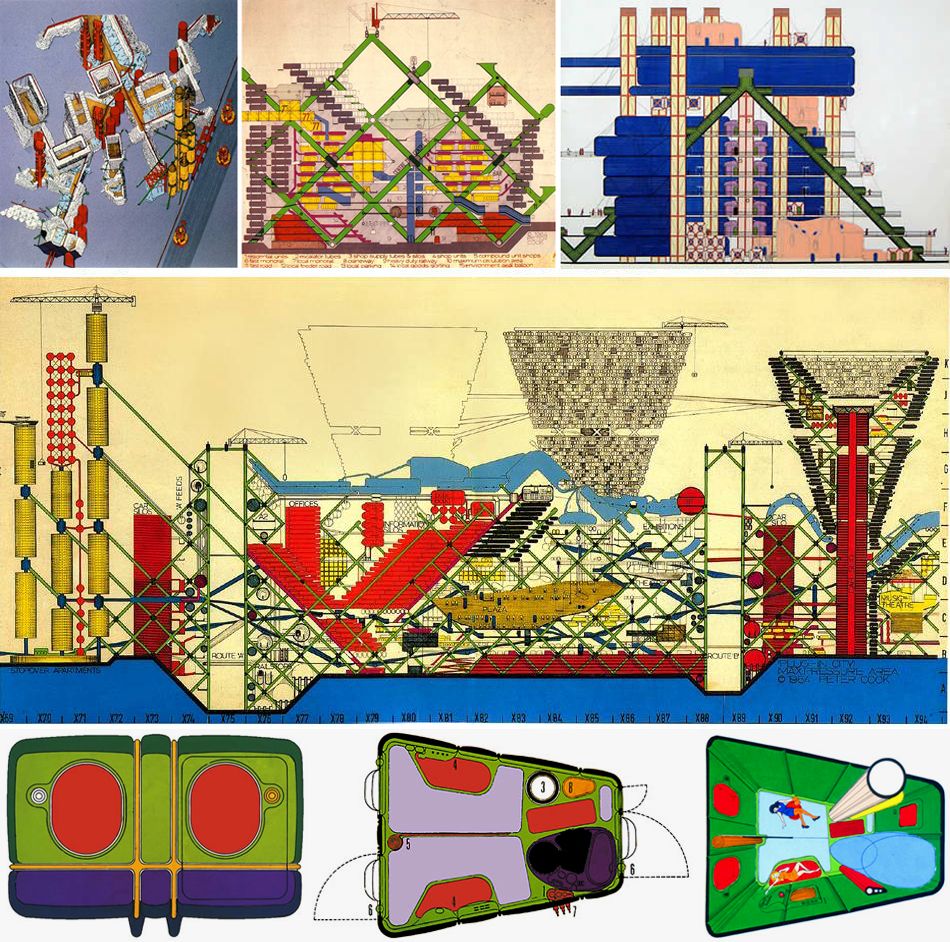
Being the nostalgia whore that I am, you can imagine my sadness at seeing the Neptune Theatre Restaurant close, and possibly Change Alley Plaza might go along with it too. I can only speculate on this piece of architecture. It seems like an extremely radical piece of architecture for the 1970s. (One entire ribbon connector pedestrian bridge with its own "inner-street" of shops and restaurants which are located in pods on either side.... plus a circular possibly revolving restaurant that arrives from space age.) Were the architects influenced by Archigram's "Plug-in City"?


I assumed that this church was built during a period when construction techniques were still fairly primitive. Nevertheless, it aspired toward achieving dynamic non-rectilinear form. That, I find very respectable in view of the limited construction technology available then. (Though I am slightly disappointed that the building is a tad bit vertical.)

I am not sure if this building references another building which I particularly like: The Philharmonie by expressionist Hans Scharoun, built in post-WWII Berlin.

The remaining photos are just other examples of early modern nation-building architecture in Singapore which I thought were special.


And this last one is a personal idiosyncratic obsession.

Thursday, January 04, 2007

HAPPY NEW YEAR

Dear readers
Happy new year from the lowlands! It is still quite warm here in Delft. Submissions are coming on the 11th January. Will post images of my work later.
Ciao ciao
Janita

Underlying questions - Ronald's post

Here's a post from Ronald. He isn't on the blog yet, so I'm posting on his behalf.

>>>

Hi there.

Ronald (the new member) here. I figured that if I didn't sit down to write my response to your post, I'll never get down to doing it. (As a disclaimer, I do not mean to be a wet blanket, but this post shall be the devil's advocate to KH's post)

I find the question of social consciousness particularly intriguing. Much of the underlying problematic is that we are trying to do it all: experimental architecture, social consciousness, public participation, personal passion/desire. Really Architecture suits the current purpose now because the over-arching umbrella is "anti-establishment" or "alternative-to-the-norm", and in a sense, puts everything in a refreshing dialogue. A common "enemy" (i.e. establishment) gives us reason to come together. This do-it-all-ness is a double-edged sword.

I start to be cautious when you suggest the need "single-mindedness" in a united approach. I am doubtful that the movement, with such a broad agenda and divergent interests of each member, can withstand unity and single-mindedness. As you aptly observed yourself, the terms of the discussion changes when you start asking yourself, "What would I like to do?" Every movement in architecture or art served a moment in history when interests converged, and inevitably had to end when interests diverged. The Bauhaus became apolitical, Team X or CIAM eventually disbanded, and the original members of the Metabolists ended up doing very different work.

It is at this point where I state my belief (that cannot be supported by logic or analysis) that no architect can be every thing to everyone. Every architect must make a personal choice on what architecture is to him, and how it relates to his self, unconsciousness, convictions, beliefs. Some choose to align themselves with art and sculpture, some with theory, some with philosophy, or with Chinese gardening, or with history. (each of these architects has to deal with the public at some point in time) The beauty is when each of these types of architecture comes into dialogue with each other.

Perhaps I could mention a few observations to explain why I raised this point. Frank Gehry is first and foremost a sculptor. His artistic ambition and goals rely only on the pursuit of that elusive form enabled by the computer. I don't know how socially conscious he was. Tadao Ando's pursues the elements of light, space, meditation, strict geometry, in a way that can touch the unconscious in the hearts of each who walks into them. I also don't know how socially conscious he was.

This brings me back to an earlier point that I mentioned that public involvement in the process should come external to the architect, as an external constraint, rather than the architect claim the additional responsibility under the guise of social consciousness. The modernist architects/planners who replaced old urban fabric with new cold spaces, after all, began with the best intentions. Our beautiful garden city with modern buildings / tabula-rasa dilemma began with the best intentions of Lee Kuan Yew and URA & HDB.

We all believe in public participation. Yes, I believe that participatory design can have the potential to achieve new kinds of spaces, possibly to higher levels of public satisfaction. But I sense that the process is not as easy as we make it out to be.

To begin with, architectural design is a long-drawn process, beginning with i)schematic design, then ii) design development, then iii) construction documents and iv) construction. Along the way, countless decisions are made. Then revisions made. Then more decisions are made, or reversed. Then revisions. You get the idea. My first question is, at which moments in this long-drawn process do we involve the public?

My second question is, in what roles do we involve the public? Are they solely the decision-makers / decision-reversers? (like clients) Or are they co-designers? (In which case, as egotistical designers with personal artistic ambition, how much of the designing role are we willing to relinquish?)

My third question is how do we obtain a reliable and constructive sample of public input or opinion? Personal A says one thing. Person B says another. Person C says another. Maybe Person A said one thing because he heard from Expert X that this thing is lousy. Person B, however said what he said, because he read an article in the Straits Times that said that this must be good and this is what he wants. Person C truly believes that Singapore is losing its Asian-ness, and the only way we can redress the problem is to add Asian roofs and moon windows to all new public architecture.

The only loose criteria we have is if Persons A, B and C unanimously like a piece of design, and hopefully Expert X and the Straits Times too. Yet, every idea must have its nemesis, for it is the most controversial designs that are the source of disagreements, raise the most critical questions, and push the scene and the discourse forward. This inherent discord/tension is imperative to the vitality of every society.

I end with a brief synopsis of a novel I recently read, Le Monument, by Elsa Triolet (Prix Goncourt winner, 1944) I don't think it's been translated into English yet.

In the novel, the protagonist Lewka is a sculptor in pursuit of what art is to him and what sculptor is to him. He is also loyal to the cause of his party, his nation, and his people. One day, he is commissioned to build a sculpture of Stalin to be viewed prominently in his city. Lewka dedicates the sculpture to his party and his people and works hard to create something that everybody will like. When he unveils his sculpture, it is instantly loved. It is well-received by the public and party-leaders alike, and Lewka receives a prestigious prize for his work. Ironically, he falls into depression and becomes deeply troubled. He ends by committing suicide. The reason-- that he has "assassinated art"

Only a tale as such could succinctly elucidate the dilemmas that lurk beneath our discussion.

re.

There's a point to everything if you feel for it - clearly, Kenghua has a passion for expeditions, like the Akha Way expedition he and Ngai Keong went for. It's hard to define what a "point" to doing something is, after all. I'm sure every endeavour has, in itself, a value, and the rewards of that value will eventually show itself in the life and actions of the participating individual/s.

As I speak, I'm talking to Ronald online about what he deems the third school of architects, rather than a third 'kind'. I'm guessing it has something to do with participatory, open-source design, and there's at least a sprinkling of social awareness into the mix as well. Hopefully, architects are beginning to evolve from self-centred bastards to culture-conscious individuals. People from the various IT industries are learning it the hard way, and I'm taking this as a cue from recent open-source phenomena - Second Life, Youtube, Wikis, Myspace etc. Think Time Magazine's Person of the Year, and think how this brings architecture into the whole picture.

I'm currently working on a project that deals with participatory design. For now, it's a media park in downtown LA that is to be wired up (or rather, wi-fi'ed up) such that the individual who visits the park is tracked, and given the data on his mobile device, is shown content that
pertains to his individual interests. (That may change through the course of the project.) I've been wanting to set up a blog on it, but been procrastinating like crazy.

Hmm I realise this isn't so much a 'response' as it is a directionless rant on my part, but what I was trying to get at is, what determines if there's a point to doing something? Does it have to fall within a capital structure that's set up for it, that will finance it? Does it have to fall within a gamut of mass-consumerist/public preferences so as it can have a value associated to it, and be deemed acceptable? (Organisations like Habitat for Humanity appeals to our collective conscience (and hence consciousness) and is therefore valued for its worthiness; other organisations with more specificity in their objectives may not appeal to us as such. Where does re:ACT place itself in such a wide-ranging spectrum of architectural vested interests?)

I'm throwing up these thoughts as re:ACT continues to find its voice (and eventual direction). We're only a year old, it's still the teething stages, and while this sounds unbearably cliche, it can't be more true - we'll have to first find ourselves as individuals before being finding ourselves as part of a collective. We do have a certain framework (no matter how defined or under-defined it may be at this point) that deals with public consciousness and social awareness that goes beyond the bounds of architecture as a self-subservient field, and hopefully that's a good place to start.

Happy new year, you all!