MAKE THE WORLD A BETTER PLACE!
REALLY?
ARCHITECTURE!
Wednesday, March 29, 2006

Tuesday, March 28, 2006
Architecture is, however, not a linear process that leads more or less logically and directly from architectural history to new buildings. On the search for the architecture I envisage, I frequently experience stifling moments of emptiness...At these moments, I try to shake off the academic knowldege of architecture I have acquired because itt has suddenly started to hold me back...I find I can breathe more freely. I catch a whiff of the old familiar mood fo the inventors and pioneers. Design has once again become an invention.
Peter Zumthor, Thinking Architecture.
I dust the photocopy off my shelf, and read again the words which once so inspired me. Architecture smarkitecture.
Monday, March 27, 2006
“ Los Angeles is surrounded by these imaginary stations that feed reality, the energy of the real to a city whose mystery is precisely that of no longer being anything but a network of incessant, unreal circulation --- a city of incredible proportions but without space, without dimension … … this city, which is no longer anything but an immense scenario and a perpetual pan shot, needs this old imaginary like a sympathetic nervous system made up of childhood signals and faked phantasms " [Simulacra and Simulation, Jean Baudrillard]
was thinking.... how about Singapore? what is the reality and hyperreal? what do people consider their home... their place?
Wednesday, March 22, 2006
Of Being a Nomad
"Such incessant and dramatic change to one's surroundings must have some effect on the Singaporean psyche. You could say it turns Singaporeans into a nation of nomads. Except that it is not the movement of the people that make it such, but the shifting of the land. Even if they stay put, the country moves around them, and Singaporeans find themselves eventually in a new place, clinging only to ghosts."- Lost at Home: A Nation's State of Geographical Confusion, Air-Conditioned Nation.
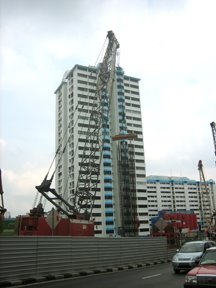
With the constant chugging and whirling of machinery from dawn to dusk (and oftentimes till midnight), the landscape ( in the broadest sense, including all manner of hardscape and built works) at Farrer Road has changed dramatically over the past year or so. Construction hoarding taken down overnight suddenly reveal reworked roads, redirected roads, relocated overhead bridges and new pedestrian paths. As the MRT construction progresses, each and every stage reveal new alterations ; the landscape stirred by an invisible stick once every month or so. However, the noise is as constant as a fly's buzz around one's head. To add to the cacophony, a steam roller rolled by the window sometime last month, in an attempt to flatten the rock garden behind the apartment and to replace it with a children's playground.
We think of moving. The thing is, everything else is moving around us.
Friday, March 17, 2006
"Preservation Ethics 2 comments
Taliesin as Textbook with Jim Erickson and Sid Robinson
Class Notes 6.20.05 | 2:30 to 4:00
What is preservation?
- rehabilitation.
- restoration.
- reconstruction.
(Usually it is a combo of the three)
It is NOT the stopping of change or reversal of change. It has many degrees of intervention... it is the managing of change.
Preservation began in the national parks service preserving our natural environment. Mount Vernon was the first historic preservation of a building. Pamela Anne Cunningham raised money to save George's home. It was saved bacause it was historically significant.
So how broadly do you define significantness???
Then you must ask, what period should it be restored to?
Basic rule of preservation: record what you found & what you did.
----------
Class Response:
Despite the blah nature of my notes, the class was actually pretty interesting. A week ago the school had just visited Wright's Home & Studio in Oak Park ... actually we visited many places including Mies' Farnsworth House, IIT, etc; but the reason I bring up the Home & Studio is that we met with the restoration architect of this recently preserved building.
The Home & Studio is sparkling. Everything is in great condition, frozen as its early 20th century self. It felt very odd. This home was not just being preserved because of its architectural significance, but also because FLLW had lived there. To preserve the home they chose a period of significance, and any changes Wright made to the property were taken out because they were not of the right period. For example, in the studio there originally stood a fireplace made of common brick. Later, Wright covered this fireplace with Roman brick to make it more "prairie style".
However in the restoration, Wright's redecoration was removed and returned to common brick. It was decided that his change to Roman brick was a move to make the house more trendy and sellable. In this instance, the historical accuracy of the home was more important than the wishes of the architect who created it. Therefore I question the validity of this decision.
----------
Anyway, beyond that simple observation, you have to ask yourself what is the point of this restoration? I love that the building is in good, livable condition. However Wright's Home and Studio was designed to be (*shocker*) a home and studio, but now this useful place has been restored into a house museum. A home has been turned into an attraction. What was the point of making it livable? You could have achieved the same affect by just building a replica down the street.
Buildings are born, they live, and they die. What does it mean when it has been frozen in time? Embalmed? I have not come up with a complete thought when it comes to this issue.
What surprised me more was when I brought these thoughts up in class. Students who in one breath screamed about the vision of the artist and the wrongness of tampering with this vision after death, were completely fine with the restoration. In fact, I was attacked for even questioning the ethics of such an act. Did I miss something?"
--megsw, Taliesin Frank Lloyd Wright School of Architecture 09/05/05 18:06
Wednesday, March 15, 2006
Monday, March 06, 2006
Architecture is perceived unconsciously and in passing, distractedly and through collective." The reception of architecture takes place tactilely through use and optically through perception, in both cases, however, it occurs less "by way of attention than by way of habit.. less in alertness than in passing." Architecture remains bound to everyday life situations-- indeed, it fulfills its task best of all in "invisible" self-evidence.-- magazine, "the everyday architecture" or smthg like that
sy
Thursday, March 02, 2006

Collaboration with Big Fishes
Well, the recent debate for our group is whether to collaborate with NUS' The Architecture Society, and being the newsmonger that I am, here's the few thread of thoughts that were exchanged through emails. Collaboration with NUS will definitely give us credibility. But at the same time we lose our guerilla-like-think-tank independence that flourishes in email exchanges and the all-equalising web. In the long run, however, reACT will have to stand on its own two feet. But what about now? What about these fledgeling years when we are trying to establish ourselves? Would we need to work with every TAS president that comes along for 5 years or so? That would stymie our work if we have to account to different people every year! And what kids they are. (age wise). Tsk tsk. :)
But, as Janita says. Let's talk.
Janita:
Definitely think its a good idea to collaborate. We will run through with DMC. I'd hate it if they try to intervene with our objectives and goals though. Will we lose independence?
Ngai Keong:
I have a feeling that what we're doing is actually a conflict of interest. This may sound very cynical, but they're not really interested in education. They're more interested in running a business! They'd be more than happy that we do our things independently.
Sern Hong:
Still, another way would be to put some of the professors/school on our 'advisory board'. if they are willing, the advisory board will be an official element in our group. This will add credibility for us. We need an agenda. need to strategise b4 any meeting & action. not wise to just barge in to any meeting. to share my 2 cents worth, Jan and I prepared a powerpoint(much like a marketing sales presentation) to DMC last year. It was rather a success as they are convinced about what we want to do and how they can benefit. Basically, we tuned the presentation in such a way that it is about 'how SDE can benefit and how they are important to us'. Still, though, i am not comfortable linking with the school, there are certain 'elements' in it that will support us. we just have to seive that out.
Szue Hann:
Yeah, was worried that they'd intervene with what we're trying to do as well. We can talk about it during Fri's meeting. Might be late cause got class til evening though.
Tuesday, February 28, 2006
Sunday, February 19, 2006
Our next exhibition is up and coming, scheduled for the first two weeks of June 2006 at the new National Library!
CROSSING BOUNDARIES 2006
Would like to share what SH is thinking of exhibiting. He can make even mundane things sound interesting. Of course, this is not to say his exhibition proposal is mundane. Far from it..
1) Verti-City (Singapore) --- This is a team work between Jawn (a fellow Singaporean friend in LA) and I. It is about an exploration of an experimental vertical growing city, based on the needs and nature of the particular city. In this case, Singapore. The end product is not a final design, rather a system logic by which Singapore can adopt to think of skyscrapers in a new perspective of city planning and architecture. Using Singapore(Marina area) as examples, the end product will be a presentation(animation movie; panels; possibly 3D models) of the process and proposal. This exhibition aims to bring about an appreciation from the public towards radical architecture proposals that can, in time to come, be a visionary piece that bring about new, fresh architecture explorations.
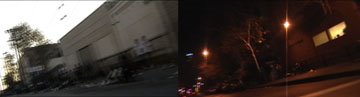
2) Moments in LA --- This is a film documentary meant to bring about architecture awareness emerging from societal phenomenon. In fast-paced Singapore, we often zip around and seldom slow down to observe the small, intricate parts of the city morphology. What is it that makes the city breathes? What makes up the city experience that we more often than not, could not describe fully? What is the ‘seen’ and ‘unseen’?
Located in Los Angeles, the 20-30min film is set in Downtown LA, depicting the lives of the homeless community in a place well-known as the centre of the movie-world --- Hollywood. The camera moves in various speeds, experimenting with the human’s visual digestion of the surroundings. The film then uses a visual method called Diptych, showing several shots simultaneously.
‘Home’ of the Homeless >>> The phenomenon of the homeless community is a sad, avoided yet true part of LA. Yet, as much as people try to ignore and avoid them, there are groups of people that work beyond their duties to provide and care for the homeless. The nomadic roaming with trolleys, smells and streetscape the homeless creates do provide an interesting architecture setting for the city.
Mobility and homelessness is their way of life. So, their lifestyle is exhibited
through the areas where they live and their 'homes'. The documentary aims to show the side of the homeless that the public do not see or avoid to see, as well as the phenomenon it affects on the city environment and culture.
Check it out, huh.
Subscribe to:
Posts (Atom)